Coasts
What is a coats?
A coast is the edge of the land where it meets the sea or ocean.
The coast, or coastline, around Britain is very varied. It includes beaches, cliffs and sand-dunes as well as mudflats, saltmarshes, shore platforms and estuaries. These features are not all found at the same place, however. Each part of the coast is different.
Coastal Erosion:
Waves have the power to erode, or break up, and wear away rocks over time. Storm, or high-energy, waves breaking at the foot of a cliff dislodge blocks of stone.
Case Study: Preston Beach Weymouth
Preston Beach Road is a major access route between Weymouth and east Dorset and an important link between Preston and Weymouth. Overcombe and Bowleaze Cove is an area with substantial homes and flats as well as commercial businesses (shops, beach restaurant and public house), car park and public toilets. Lodmoor RSPB Nature Reserve is a large area of low-lying land located directly behind Preston Beach Road, between Weymouth and Overcombe. It is designated a Site of Special Scientific Interest (SSSI).
Preston Beach Road is currently defended by a sea wall, a rock groyne at the southern end of the road and ongoing beach nourishment schemes.
Coatal Processes:
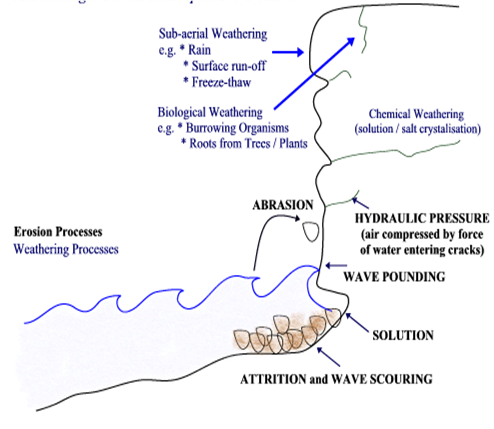
1. Abrasion (corrasion) - this is where breaking waves hurl rock fragments against the cliffs gradually wearing away the cliff material.
2. Hydraulic Pressure - this is where erosion occurs due to the pressures exerted by breaking waves as air trapped in cracks in the cliff is compressed by the water. This compression and sudden release gradually forces the cracks apart.
3. Solution (corrosion) - this is where salt water can act to dissolve some chemicals in the rocks, for example in limestone, calcium carbonate is dissolved, weakening the rock.
4. Attrition - as rock fragments are swirled around by waves they are gradually broken down as they hit against each other.
5. Wave scouring - waves breaking at the base of the cliffs swirl around the base and result in the removal of loose rock.
6. Wave Pounding - breaking down of the cliff face due to the sheer force of the wave which can exert upwards of 30 tonnes / m2 when crashing on the cliffs.
As well as the action of the sea causing the erosion of the cliffs, weathering processes and human activity can also be responsible for affecting the wearing away of the rock.
There are also weathering processes:
With weathering, unlike erosion, it has to do with the breaking off taking place in situ which is where it tends to stay put.
Freeze-thaw processes (as water freezes and thaws in cracks in cliffs, the expansion and contraction forces the rock open, making them more susceptible to the action of waves).
Chemical weathering - water running down the face of cliffs, either from surface runoff from above or from rainfall can result in solution so that rock cracks are enlarged, leaving the remaining rock loosened
Biological weathering - burrowing organisms and roots of vegetation forces open cracks, making them more susceptible to wave erosion) [NOT sub-aerial]
Coastal Landforms:
 |
