Earthquake
An earthquake is caused by sudden, violent shifting of massive rocks called plates under the earth's surface. This movement of the plates releases stress that accumulates along geologic faults. A fault is a deep crack that marks the boundary between two of these plates. Earthquake belts occur along faults around the world. Many run along coastal areas. The San Andreas fault in central California is well-known for causing severe earthquakes.
Types of Seismic Waves:
Earthquake shaking and damage is the result of three basic types of elastic waves. Two of the three propagate within a body of rock. The faster of these body waves is called the primary or P wave. Its motion is the same as that of a sound wave in that, as it spreads out, it alternately pushes (compresses) and pulls (dilates) the rock. These P waves are able to travel through both solid rock, such as granite mountains, and liquid material, such as volcanic magma or the water of the oceans.
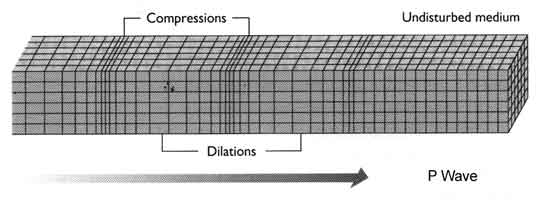
The slower wave through the body of rock is called the secondary or S wave. As an S wave propagates, it shears the rock sideways at right angles to the direction of travel. If a liquid is sheared sideways or twisted, it will not spring back, hence S waves cannot propagate in the liquid parts of the earth, such as oceans and lakes.
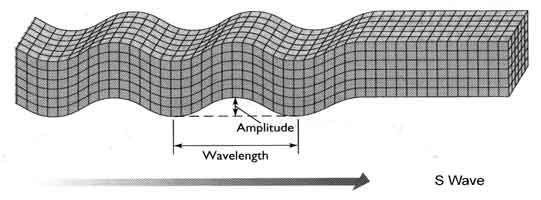
Surface waves travel over the surface of the earth. Surface waves -- sometimes called long waves, or simply L waves -- are responsible for most of the damage associated with earthquakes, because they cause the most intense vibrations. Surface waves stem from body waves that reach the surface.
Case Study: Kobe earthquake
Case Study: Bam Earthquake

